
MATH
Welcome to Mr. F’s Kick-Start Math
Creating mathematicians and logicians through games, puzzles and problem solving

Developmental Math Games

Tips:
Game boards should be enlarged onto 11x17 paper for ease of use with young children.
Games involving playing cards use only Ace -10. Instruction may be needed in how to count the cards (not to include the smaller suit under the number). This aides a child who may benefit from counting, e.g. to find a total of two cards.
Dealing with the inevitable, “they cheated” while the class is playing math games. Try announcing that everyone in the classroom should cheat on their turns for the next 5 minutes. Of course that quickly becomes boring so discuss that, along with how rules make it fun and fair for everyone and why no one likes to play with cheaters. They can also learn a lesson that rules are community agreements of trust, and can be changed if the players all agree.
A Bit of My Methods
K-3 students doing algebra? Sure, just make it ‘concrete’ and puzzle-like which allows their own logic and computation skills to go to work.
For example: 3X=15 can become “What same number, added three times, makes 15?” (* try: ‘when tripled makes 5’) Similarly, “Double my age and subtract 10 and you’ll have 8? How old am I?” translates back to solving 2X-10 = 8. It’s surprising how logic and a few problem solving techniques (such as guess and check) allow the young mind to master mental math early on. All while having fun thinking hard! “Remember, class, the joy of puzzles is in puzzling”, was my quotidian reminder. *The daily challenge problems are optional but there are always some takers.
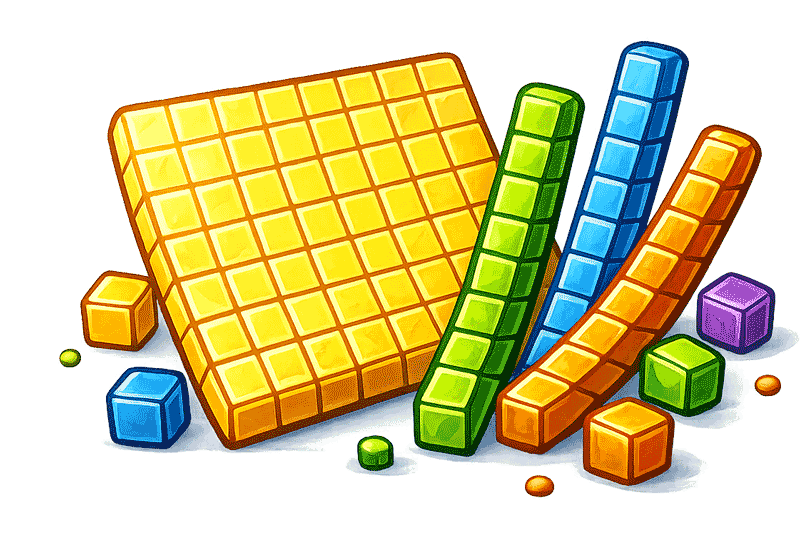
The most important manipulative for learning about our number system is base 10 blocks. Counting, place value, computation, fractions and percents/decimals can be concretely explored successfully through explicit instruction and focus on solving multi-step problems daily, as in the summer books.
My hands-on instruction was done in groups on the floor, using manipulatives (plastic money, fraction circles, hand-held clocks, rulers, etc.) and posing questions (sometimes as a group, sometimes individually) that made them uncover or practice important aspects about the concept for the day. One smaller group for those needing more/repeated instruction, and two larger groups. Two different levels of math practice daily, where they copy and solve 5-6 problems in a notebook and then explain to me (no point in copying someone’s answers) and later to their parents, how they solved them.
Happy puzzling to you and your students!
Here's a peek into my classroom


Summer Math Books:
See a collection of multi-step problems used in 1/2/3 grade classroom over the course of a year. Be sure not to miss the last section, puzzles fitting to all grades, more or less.
